My Child New Beginnings how to keep your child happy comes down to three things: keep the three need meters out of red, match your reply to the mood she is actually in, and spend real time with her. Nothing else in the game matters as much, because a child whose meters are red, or who does not trust you, will not open up no matter how well you phrase the question.
On this page
The three need meters, and what to do about them
Three need meters sit in the top-right of the screen:
Entertainment (fun and play), raised by playing with the child and talking to them.
Cleanliness, raised by bathing, washing her face and trimming her hair. Bathing means tapping the bathtub, and if the child moves slowly you drag the sponge into her hand. In the newest build the child can bathe herself, which players read as visible growth.
Hunger (fullness), raised by feeding them.
They turn red when a need becomes critical, and if they are left in that state the child develops health problems. Red is the thing to react to immediately, not at the end of the day. Fishing on a weekend is the cheapest way to spend time together and still feed her.
Mood is a separate axis
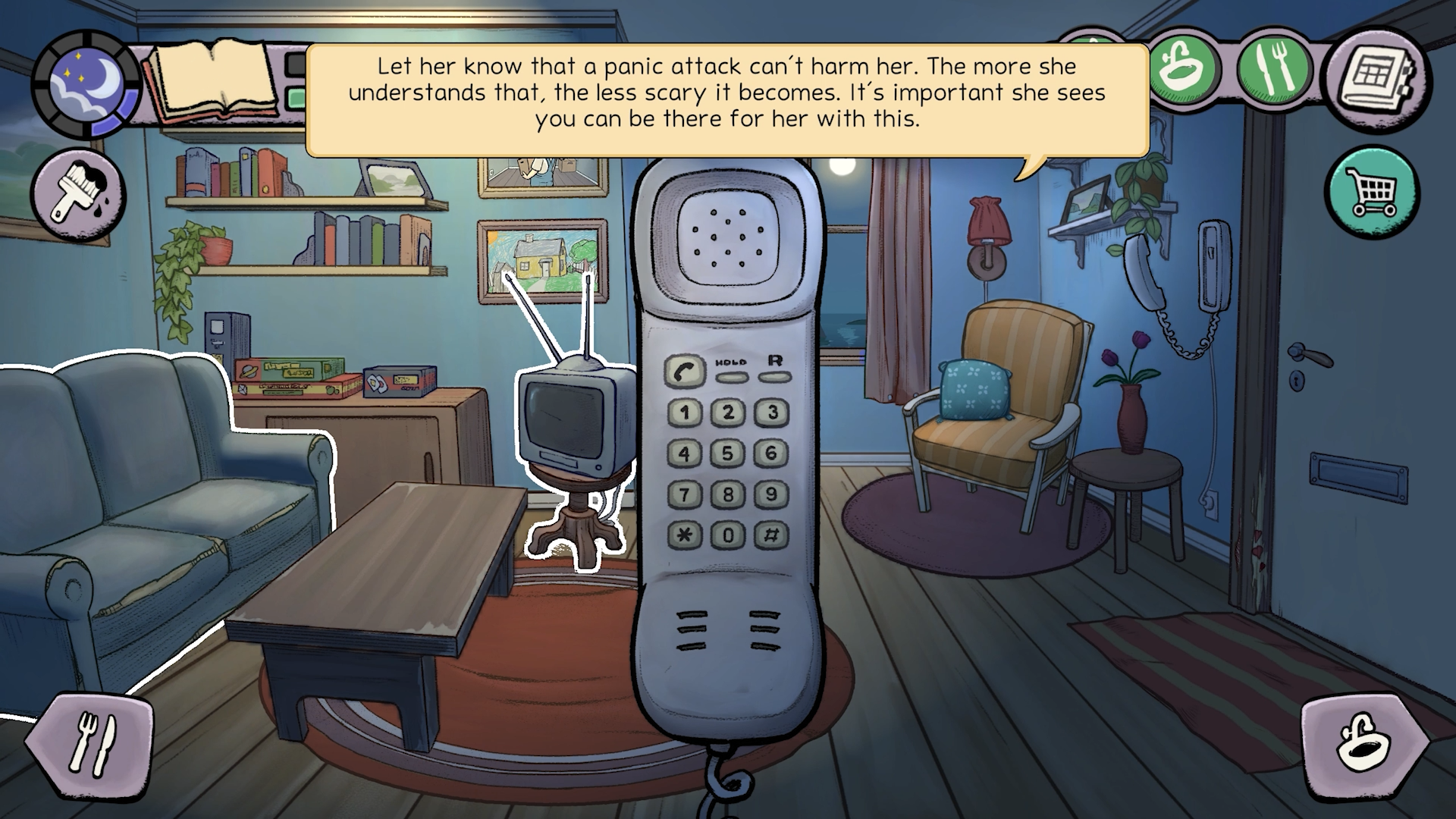
The child moves through emotional states - anxiety, frustration, anger - and the game expects you to pick your response according to the state she is in rather than answering generically. A panic attack is calmed with breathing techniques, and before-school anxiety is handled the same way, with breathing and counting 3-2-1 to bring the child down.
Talk the worry through and listen carefully. Do not force play on a child who is tired or frightened, and keep the routine stable - her reaction to the day shows in how she moves and what she picks up. When the child says she does not want to go to school because of what others might say, the game expects you to listen and reassure rather than push her out of the door. That conversation is the hardest one in the game, and it is covered here.
My Child New Beginnings how to keep your child happy: what actually works
Playing: ball, hide and seek, tic-tac-toe.
Drawing - the in-game drawing game is called Power Doodle.
Reading and bedtime stories.
Fishing on weekends.
Collecting berries.
The walk to and from school.
Cooking and crafting food together.
Helping with homework, which improves the report card.
Giving gifts and taking the child to the park.
Letting the child pick up the small things they find, like a horn-shaped piece of wood or old boots.
Comfort activities also raise the child's trust, so they work twice. At the end of a chapter the game reports how much Empathy, Optimism, Assertiveness and Trust the chapter produced. The choices that quietly undo all of this are listed here.
Feeding in practice
Cook at home from fish and berries, or order in: go to the living room, tap the telephone on the right, pick the pizza shop contact and order. The options include "A Hawaiian please, with extra pineapple", "One pepperoni pizza" and "A Margherita please", and the shop replies "Coming right away!". Takeout costs 100 coins, which is why fishing and cooking yourself is cheaper.
You must drag the food from the plate onto the child - leaving the plate nearby does not raise fullness. Feeding the child nothing but plain porridge for a long time earns complaints, and a properly cooked fish dish clears the complaint. When the money runs out, the free options are fishing at the river and picking blueberries in the wild.
When to talk to her
Ann, the friend who supports you, sets out the game's own guidance: pick a time when the child is relaxed, such as evening during dinner or on the weekend, and check in with her. Be curious and do not put words in her mouth. Let her find her own words and guide her only when she struggles. Do not rush to say that everything will be fine, because she needs to know it is all right not to be in control, to feel weak or lost. Let her feel her feelings, and encourage her to draw them.
Ann also warns against the wrong moments: if she has just had a panic attack she needs rest rather than a barrage of questions, and the time right after she comes home from school, when she is emotionally drained, is not the time to push her to talk.
The long game
Sarepta Studio developed the game with child psychologists, and the stated support techniques are breathing exercises and self-esteem building, balancing comfort against challenge and closeness against boundaries. The child recovers slowly and unevenly, because trauma is treated as something to be understood and lived with rather than solved. Progress shows up as trust, better sleep, less withdrawal and a willingness to talk, not as a stat that fills up. The choices that quietly undo this are listed here.
FAQ
What are the three need meters?
Entertainment, cleanliness and hunger. They sit in the top-right of the screen and turn red when a need becomes critical, and the child's mood is tracked on a separate axis.
Do I choose a boy or a girl?
You adopt one of two preteens, Karin or Klaus. The story follows the two of you two years after a series of traumatic events, as you move into a proper home in a new village in Norway.